Tuesday, May 30, 2017

What Do Buyers and Sellers Pay in Closing Costs?

Rarely does a buyer or seller show up to the closing without knowing exactly what their costs of sale will be.

In fact, based on the mortgage loan amount of the purchase/sale price, it’s not hard to ballpark either side’s closing costs. Before you get too far along in the process, ask your real estate agent or mortgage professional for an estimate.

Once you have a real, live deal with a closing date, you should be able to know your costs pretty close to the penny.

If you’re new to real estate or haven’t bought or sold in a while, here’s what you need to know about closing costs.

Buyers have a higher number of costs

In a closing, both buyers and sellers have costs. Usually, the buyer is faced with more line-item expenses than the seller (although sellers pay more).

For starters, most buyers are getting loans to make the purchase, and many of the charges stem from the loan.

A buyer should receive a loan estimate form early on in the sale process. This document spells out all the approximate costs the buyer will face when making the purchase, so there aren’t any surprises at closing. Some buyers use the information on the loan estimate form to shop for different lenders, interest rates and costs.

Typically, buyers getting a loan will see some of the following costs:

  • Appraisal fee
  • Origination fee
  • Prepaid interest
  • Prepaid insurance
  • Flood certification fee
  • Tax servicing fee
  • Credit report fee
  • Bank processing fee
  • Recording fee
  • Notary fee
  • Title insurance

Be sure to go through these fees line by line with your mortgage professional to understand exactly what they are and how they apply to your loan.

Aside from the expenses of getting a loan or buying a home, some expenses, such as property taxes or homeowners association dues, are pro-rated and paid at the time of closing. For example, if you’re buying a home and you close toward the end of the property tax period, you’ll likely need to pay the balance of taxes upfront.

The same holds true for prepaid loan interest. If you close toward the end of the month, the lender may ask for the first month’s payment up front.

Negotiate sharing some of the costs

Coming up with an extra one to two percent toward closing costs can be a bigger deal than a $5,000 reduction in the purchase price, so ask the seller to pick up some of the closing costs as a part of the negotiation.

Credit for $5,000 to go toward closing costs will be a much greater bang for the buyer’s buck. The price reduction won’t amount to much more than a few dollars per month over the length of the home loan. But saving $5,000 at the closing will be money right back in the buyer’s pocket.

Sellers pay the commission

For sellers, there are always fewer line items on an estimated closing statement. But the seller generally bears the biggest brunt of the fees: the real estate commission.

The commission is based on a percentage of the total sale price, so it tends to be the biggest fee. In addition to the real estate commission, sellers may have to pay the balance of their property taxes, if they haven’t done so already, as well as any prorated homeowners association dues.

Related:

Note: The views and opinions expressed in this article are those of the author and do not necessarily reflect the opinion or position of Zillow.

Originally published December 6, 2013.


from Zillow Porchlight https://www.zillow.com/blog/who-pays-closing-costs-140343/

Tuesday, May 23, 2017

Renters: Are You Ready to Buy a Home?

For renters planning to buy a home, preliminary steps like creating a budget and saving for a down payment are obvious. Here are five more advanced steps toward moving out of your rental and into a dream home of your own.

Understand the full cost of homeownership

As a renter, a single rental fee covers your monthly housing payment. But as a homeowner, four main factors go into your monthly housing payment: principal, interest, taxes and insurance (P.I.T.I.). Understanding these costs will help you determine how much house you can afford.

Together, principal and interest comprise your monthly mortgage payment, with the principal paying down your loan balance each month, and the interest paying your fee for borrowing the money. Use a mortgage calculator to determine how much of your payment goes toward principal versus interest each month.

Taxes refer to property taxes, which are assessed by the county you live in. They average 1.2 percent of your home’s value each year.

Insurance — paid to a homeowner’s insurance company of your choice — is required when you have a mortgage. Lenders require that your insurance cover the cost of rebuilding the home if it is ruined by fire or other disaster. This “replacement cost” is determined by your insurer, and must be agreed to by your lender. Insurance will typically cost $700 to $1,200 per year for a single family home.

For condo owners, there’s a fifth monthly cost category: homeowners association (HOA) dues. These fees cover common area amenities, landscaping, ongoing upkeep and reserves for future maintenance like roof replacement or exterior painting. These monthly dues range from $100 for cheaper condos to $1,000 or more for luxury condos.

Single family home buyers can take a useful cue from HOA budgets, which generally require that at least 10 percent of dues go toward reserves. Even if you’re not buying a condo, it’s a good idea to set up a similar savings plan for future maintenance like replacing a roof or major appliances.

Know your homeowner tax benefits

Mortgage interest and property taxes are deductible when you file your annual tax returns, and reduce taxable income.

These deductions significantly lower your cost of homeownership. For example, for a $300,000 home with 20 percent down and a 30-year fixed mortgage at 4 percent, monthly P.I.T.I. is about $1,545. Tax deductions reduce this total housing cost to about $1,215.

Study rent-vs.-buy math

Often, people judge the cost of renting vs. buying by comparing P.I.T.I. to a rental payment. But to get an apples-to-apples comparison, you actually have to look at after-tax-benefit homeownership costs and rent costs.

Using the example above of a $300,000 home that costs $1,215 per month after taxes, you could compare this residence to a home that rents for about $1,200. If the $300,000 home was more spacious or in a more desirable area, the math would seem to favor buying — but don’t forget this example requires a $60,000 down payment.

Identify mortgages that fit your budget and timeline

If you don’t have 20 percent to put down, you can still get a mortgage with as little as 3 percent down. However, if your down payment is less than 20 percent, you’ll have to pay mortgage insurance, which is about .85 percent of your loan amount, and isn’t tax deductible.

Your monthly P.I.T.I. (which includes mortgage insurance) is about $1,995 on a $300,000 home with 3 percent down and a 30-year fixed mortgage at 4 percent. After tax deductions, this total housing cost drops to about $1,614. And you’d only need $9,000 for the down payment.

You can also lower your rate and P.I.T.I. with a shorter-term loan like a 5-year ARM, but rates on these loans will adjust in 5 years, so you risk having a much higher payment if you plan to stay in the home longer than that.

Start preparing your credit score now

Credit scores are critical for getting the best mortgages with the lowest rates. Lenders want reliable on-time payment history as well as credit depth.

More credit accounts are better, so renters with only one credit card should consider obtaining more credit. Just note that your credit score can drop 5 to 15 points when you first open a new account, then will come back up when you’ve established a good payment history.

Have questions about purchasing a home? Check out our Home Buyers Guide.

Related:

Originally published January 5, 2015.


from Zillow Porchlight https://www.zillow.com/blog/renters-prepare-to-buy-a-home-167285/

Friday, May 19, 2017

Oscar-Winner Jeff Bridges Sells His Montecito Mansion (at a Discount)

Kylie Jenner's Rent Is More Than Most Americans' Annual Salary

It’s not hard to figure out where Kylie Jenner’s penchant for real estate comes from. She undoubtedly picked up a few tips from her mom, frequent home buyer Kris Jenner, who will be the executive producer on Scott Disick’s new home flipping show, “Royally Flipped.” But unlike with many of Kylie’s previous transactions, it doesn’t appear she’s looking for a profit this time.

Jenner is renting a Beverly Hills pad that’s on the market for a whopping $35 million. Set on four sprawling acres with a private golf course, a tennis court, and a vineyard, the home offers a lot for that price tag.

The luxurious 5-bed, 8-bath home is certainly Kardashian-worthy. Towering floor-to-ceiling windows draw attention to sweeping views of the ocean, mountains and city. But the best view is from the back of the curved home, where an upper-level balcony provides a breathtaking hilltop view of Los Angeles.

Photos from Zillow listing

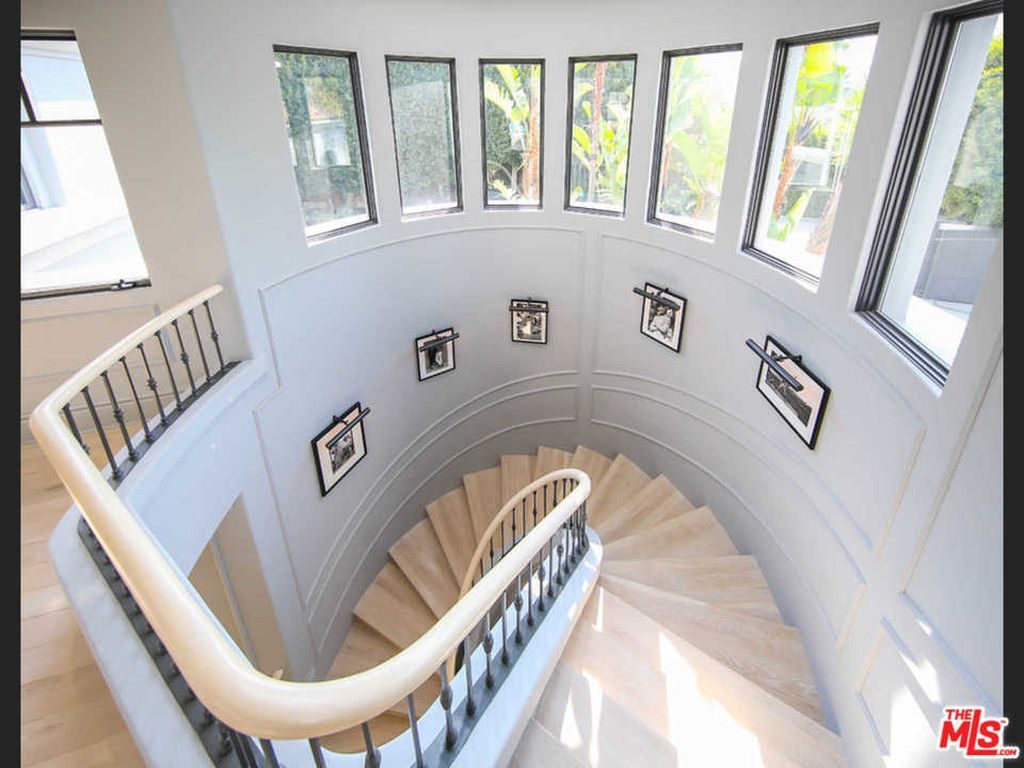
Also tucked away in the 10,050-square-foot home: a comfy home movie theater, a 300-bottle climate-controlled wine cellar, and a library with its own bar. If you follow the spiral staircase up to the second story, you’ll find a master suite with a fireplace, a separate seating area, two walk-in closets and a gorgeous marble bathroom. French doors off the master bed also lead to a smaller private terrace.

Behind the house, a well-manicured backyard offers up a pool, an outdoor kitchen, a fireplace and multiple seating areas with their own fire pits. It would be hard to find a backyard more worthy of a hosting a dinner party.

The home is also listed for sale, so if someone scoops up this unbelievable property, Kylie might have to be on the lookout for another rental.

Related:


from Zillow Porchlight https://www.zillow.com/blog/kylie-jenner-35m-mansion-216041/

Thursday, May 18, 2017

'Real Housewife' Yolanda Hadid's L.A. Home Sells for $4.995M

U.S. Homeowners Spend $15,000 in Hidden Costs to Sell a House

Selling a home not only takes time, but also costs money. To help with budgeting, Zillow and Thumbtack identified several common - but often overlooked - seller expenses.

From closing costs to home prep projects like carpet cleaning, U.S. homeowners can expect to spend more than $15,000 on these extra or hidden costs to sell the median home, according to Zillow and Thumbtack’s Hidden Costs of Selling Analysis.

Closing costs

The two largest closing costs are agent commissions and, in most states, sales or transfer taxes.

Nationally, sellers spend $12,532 for both closing costs on the median home. Sellers should also prepare for a variety of other smaller closing costs, including title insurance and escrow fees.

Home prep costs

Most sellers will complete at least one home improvement project before listing.

While some sellers prefer to complete these projects themselves, those who outsource can expect to spend more than $2,650 nationally to cover staging, carpet cleaning, interior painting, lawn care and house cleaning - five of the most popular seller home prep projects.

Location, location, location

As with all things real estate, these extra costs can vary significantly by region.

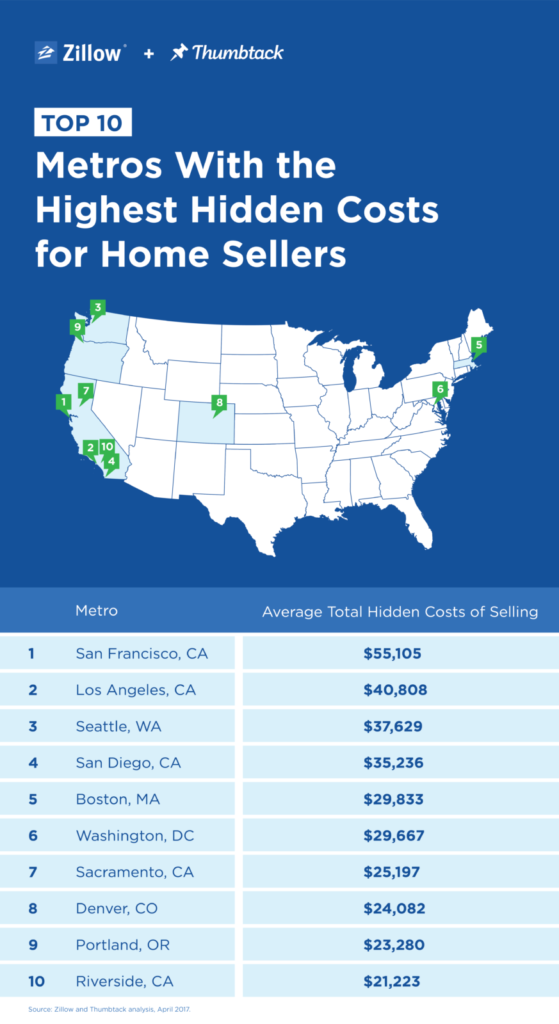
In San Francisco, homeowners can pay more than $55,000 on the median home to cover these combined closing costs and maintenance expenses - the highest among the markets analyzed.

Compare that to Cleveland, OH where home sellers pay just over $10,000 for the same costs.

Estimating profit

Even though selling a home costs money, most (73 percent) of sellers are still satisfied with the transaction, according to the Zillow Group Report on Consumer Housing Trends.

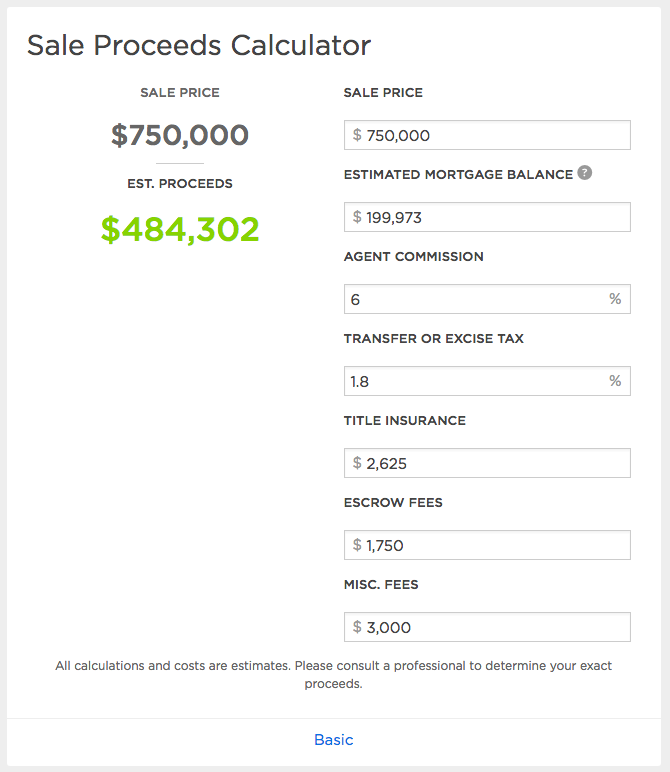
To estimate potential profit, sellers who have claimed their home on Zillow can use Zillow’s Sale Proceeds Calculator. It factors in the home’s sale price, mortgage balance and agent commissions, along with other common seller fees.

Curious how your metro stacks up for sellers? Here’s a breakdown of the metros analyzed in the report:

Looking for more information about selling your home? Check out our Sellers Guide.

Related:


from Zillow Porchlight https://www.zillow.com/blog/hidden-costs-of-selling-home-215952/