Monday, January 22, 2018

How Do Co-Borrowers' Credit Scores Affect a Home Purchase?

Whether you’re a seasoned or first-time home buyer, be prepared to know your FICO score and have a firm understanding of your credit history. And if you’re buying with another person, their credit history can affect your joint home purchase.

What is a FICO score?

First things first - what’s a FICO score and why does it matter? FICO is an acronym for the Fair Isaac Corporation, the company that developed the most commonly used credit scoring system. Everyone is assigned a number ranging from 300 to 850. The number assesses your credit worthiness through previous payment history, current debt, length of credit history, types of credit and new credit. For the purpose of buying a home or obtaining a loan, it’s the score most commonly used by lenders to determine the borrower’s level of risk. Many people simply refer to the FICO score as “credit score,” so we’ll do that moving forward.

Which score do lenders look at?

Typically, your lender will look at three credit scores reported from each of the three credit bureaus - Experian, TransUnion and Equifax - and then take the median score of the three for your application. Borrowers should hope for at least a 680, which is generally the minimum score for getting approved for conventional loans. For borrowers with lower credit scores, FHA loans allow a 580 score, or even as low as 500 if a 10 percent down payment is made. In any case, the higher the score, the better interest rate you’ll be offered.

Should I apply with my spouse or alone?

Deciding whether or not to include a spouse or a co-borrower on a mortgage application often comes down to whether it makes the most financial sense.

There’s not a ton of wiggle room when it comes to qualifying for a loan. You typically qualify or you don’t. If the only way you can qualify for the loan is by applying jointly to include the total income of both borrowers, then that might be your only option. But even if your credit and income are good enough to qualify for a loan on your own, applying together still might be a better option, as each scenario has its tradeoffs.

My partner has bad credit

When applying jointly, lenders use the lowest credit score of the two borrowers. So, if your median score is a 780 but your partner’s is a 620, lenders will base interest rates off that lower score. This is when it might make more sense to apply on your own.

The downside in applying alone, however, limits you to just your income and not the combined amount from you and your partner. While your credit score might be better, having a lender evaluate you on only your income could lower the total loan amount you qualify for.

If having your name on the home is a big deal, don’t worry. You can still be on the title of the home, just not on the mortgage.

Photos courtesy of Shutterstock.

Related:


from Zillow Porchlight https://www.zillow.com/blog/joint-mortgage-credit-scores-224438/

Who Owns the Home When Two Names are on the Mortgage?

When couples start a new journey as homeowners, questions can linger as to whose name (or names) should be listed on the mortgage and title. Many couples want a 50/50 split, indicating equal ownership to the asset, but sometimes that isn’t the best financial decision. Plus, with more than one person on the loan, the legalities of who owns the home can get tricky. A home is often the largest purchase a couple or an individual will make in their lifetime, so ownership can have big financial implications for the future.

Title vs. mortgage

For starters, it’s important to note the difference between a mortgage and a title. A property title and a mortgage are not interchangeable terms.

In short, a mortgage is an agreement to pay back the loan amount borrowed to buy a home. A title refers to the rights of ownership to the property. Many people assume that as a couple, both names are listed on both documents as 50/50 owners, but they don’t have to be. Listing both names might not make the most sense for you.

Making sense of mortgages

For many, mortgages are a staple of homeownership. According to the Zillow Group Consumer Housing Trends Report 2017, more than three-quarters (76 percent) of American households who bought a home last year obtained a mortgage to do so.

When a couple applies jointly for a mortgage, lenders don’t use an average of both borrowers’ FICO scores. Instead, each borrower has three FICO scores from the three credit-reporting agencies, and lenders review those scores to acquire the mid-value for each borrower. Then, lenders use the lower score for the joint loan application. This is perhaps the biggest downside of a joint mortgage if you have stronger credit than your co-borrower.

So, if you or your partner has poor credit, consider applying alone to keep that low score from driving your interest rate up. However, a single income could cause you to qualify for a lower amount on the loan.

Before committing to co-borrowing, think about doing some scenario evaluation with a lender to figure out which would make more financial sense for you and your family.

True ownership

If you decide only one name on the mortgage makes the most sense, but you’re concerned about your share of ownership of the home, don’t worry. Both names can be on the title of the home without being on the mortgage. Generally, it’s best to add a spouse or partner to the title of the home at the time of closing if you want to avoid extra steps and potential hassle. Your lender could refuse to allow you to add another person - many mortgages have a clause requiring a mortgage to be paid in full if you want to make changes. On the bright side, some lenders may waive it to add a family member.

In the event you opt for two names on the title and only one on the mortgage, both of you are owners.

The person who signed the mortgage, however, is the one obligated to pay off the loan. If you’re not on the mortgage, you aren’t held responsible by the lending institution for ensuring the loan is paid.

Not on mortgage or title

Not being on either the mortgage or the title can put you in quite the predicament regarding homeownership rights. Legally, you have no ownership of the home if you aren’t listed on the title. If things go sour with the relationship, you have no rights to the home or any equity.

To be safe, the general rule of homeownership comes down to whose names are listed on the title of the home, not the mortgage.

Photos courtesy of Shutterstock.

Related:


from Zillow Porchlight https://www.zillow.com/blog/home-ownership-two-names-mortgage-224435/

Tuesday, January 16, 2018

10 Things You Need to Do When Buying A Home

A home is often the biggest financial investment you’ll make in your lifetime. In fact, a recent Zillow analysis reports that the typical American homeowner has 40 percent of their wealth tied up in their home.

Several years ago, I wrote a complete guide to financial planning on one index card, which went viral and later became a book: “The Index Card: Why Personal Finance Doesn’t Have to Be Complicated” (co-written with Helaine Olen).

Now, following up on my original index card, I’ve written a guide on buying a house. Below is the housing index card - a handy resource to print out and take with you as you look at houses or think about buying one, plus some additional advice as you contemplate making the big decision.
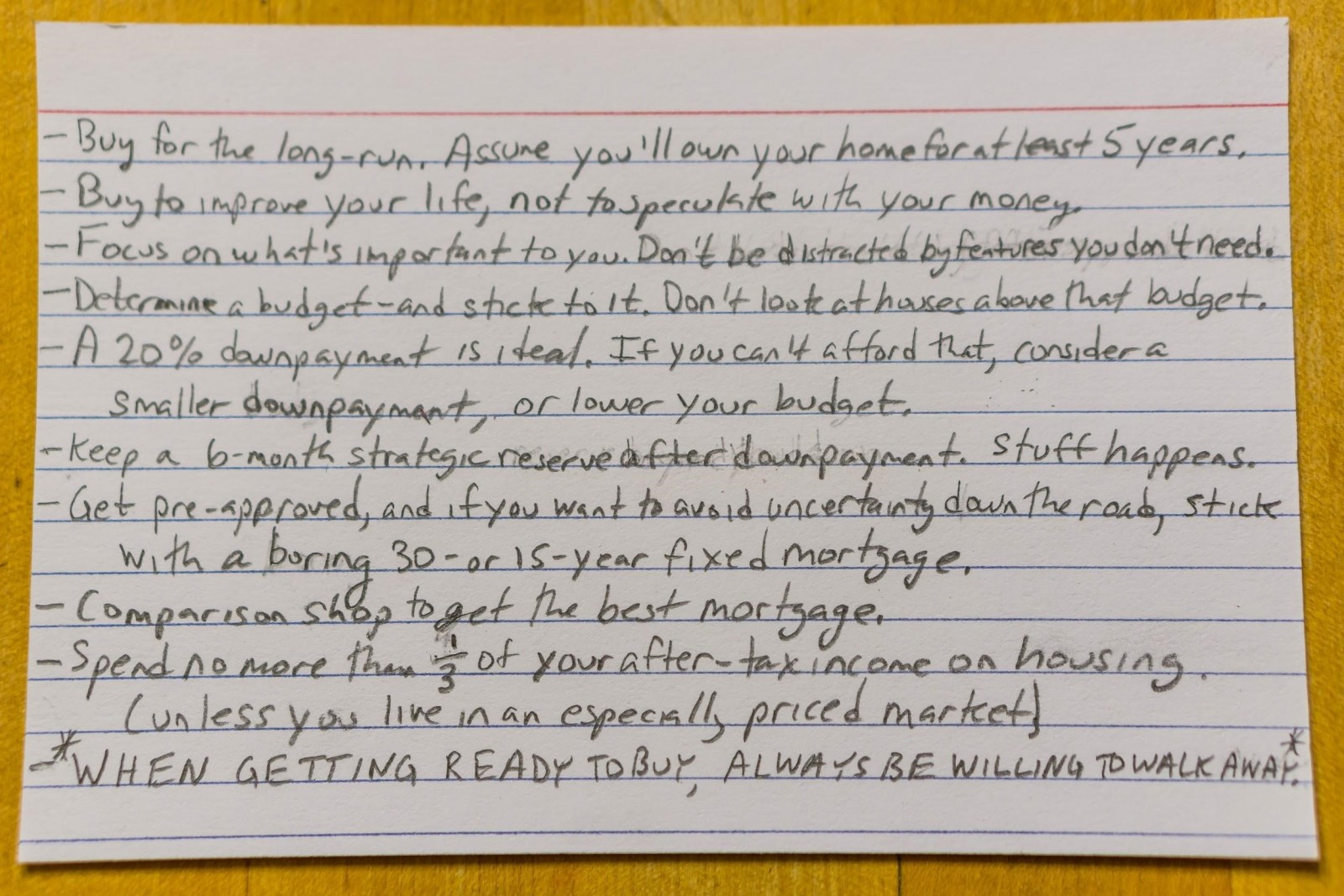
1. Buy for the long run. Assume you’ll own your home for at least five years.

A home is a significant investment, not to mention a linchpin of stability. According to the Zillow Group Consumer Housing Trends Report 2017, the majority of Americans who sold their homes last year had lived in their home for at least a decade before selling.

Some are even staying for the long haul. Almost half (46 percent) of all homeowners are like me - living in the first home we ever purchased. In short: Buy a home you want to live in - one equipped (or ready to be equipped) with the features and space you need, both now and in the future.

2. Buy to improve your life, not to speculate with your money.

Your home is more than a financial investment; it’s where you sleep, eat, host friends, raise your children - it’s where your life happens.

The housing market is too unpredictable to buy a (primary) home purely because you think it will net a big short-term financial return. You will most likely be living in this home for several years, regardless of how it appreciates, so your first priority should be finding a home that will meet your needs and help you build the life you want.

3. Focus on what’s important to you. Don’t be distracted by features you don’t need.

Today’s housing market is short on inventory, with 10 percent fewer homes on the market in November 2017 than November 2016.

So, focus on finding a home you can afford that meets your needs - but don’t get distracted by shiny features that might break your budget. Nice-to-have features often drive up the price tag for things you don’t particularly value once the initial enjoyment wears off.

Make a list of your basic needs, both for your desired home and for your desired neighborhood. Stick to finding a home that meets these needs, without buying extra stuff that adds up.

4. Determine a budget and stick to it. Don’t look at houses above that budget.

It’s important to set a budget early - ideally before you even start looking at homes. In today’s market, especially in the more competitive markets, it’s incredibly easy to go over budget - 29 percent of buyers who purchased last year did.

The most common culprit? Location. Zillow’s data indicates that urban buyers are significantly more likely to go over budget (42 percent) than suburban (25 percent) or rural (20 percent) buyers.

There’s nothing inherently wrong with that. Local schools matter, and psychologists tell us that a short commute improves your life. But be realistic about your local market and about yourself. Know what you’re willing to compromise on - be it less square footage, home repairs or a different neighborhood.

5. A 20 percent down payment is ideal. If you can’t afford that, consider a smaller down payment, or lower your budget.

If you can afford it, a 20 percent down payment is ideal for three reasons:

  • Buyers who don’t put a full 20 percent down pay a premium, most commonly in the form of private mortgage insurance (PMI). This is less financially punishing than it used to be, given today’s low mortgage rates. A monthly mortgage payment (with PMI) may be lower than a monthly rental payment in many markets - but still.
  • Buyers who put more down upfront typically make fewer offers and buy faster than those who put less down. Zillow research found that buyers with higher down payments make 1.9 offers on average, compared to 2.4 offers for buyers with lower down payments (after controlling for market conditions).
  • A higher down payment reduces your financial risk. You don’t want to owe more money than your house is worth if local markets dip when you need to sell.

6. Keep a six-month strategic reserve after down payment. Stuff happens.

While a down payment is a significant expense, it’s also important to build up a strategic reserve and keep it separate from your normal bank account.

This reserve should cover six months of living expenses in case you get sick, face an unexpected expense or lose your job. A strategic reserve will not only save you from financial hardship in the event of an emergency but also provide peace of mind.

When we accumulated a strategic reserve, my wife and I finally felt ready to build for our future. Without it, we were living from paycheck to paycheck, anxiously managing our cash flow rather than saving or budgeting.

7. Get pre-approved, and if you want to avoid uncertainty down the road, stick with a boring 30- or 15-year fixed-rate mortgage.

The pre-approval process requires organizing all your paperwork; documenting your income, debt and credit; and understanding all the loan options available to you. It’s a bit of a pain, but it saves time later. Pre-approval also shows sellers that you’re a reliable buyer with a strong financial footing. Most importantly, it helps you understand what you can afford.

There are a variety of mortgage types, and it’s important to evaluate all of them to see which is best for your family and financial situation. Those boring 30- and 15-year mortgages offer big advantages.

The biggest is locking in your mortgage rate. In short: A 30-year fixed mortgage has a specific fixed rate of interest that doesn’t change for 30 years. A 15-year fixed mortgage does the same.

These typically have lower rates but higher monthly payments, since you must pay it off in half the time. Conventional fixed-rate mortgages help you manage your household budgeting because you know precisely how much you’ll be paying every month for many years. They’re simple to understand, and current rates are low.

One final advantage is that they don’t tempt you with a low initial payment to buy more house than you can afford.

8. Comparison shop to get the best mortgage.

Though a home is the biggest purchase many of us will ever make, most home buyers don’t shop around for a mortgage (52 percent consider only a single lender).

I certainly didn’t. This did save me some annoying phone calls and hassle, but it cost me $40 or $50 every month, for years. The difference of half a percentage point in your mortgage rate can add up to thousands of dollars over the lifetime of the loan. It’s important to evaluate all the available options to make sure you’re going with the lender who meets your needs - not just the first one you contact.

The three most important factors to buyers are that the lender offers a loan program that caters to their specific needs (76 percent), has the most competitive rates (74 percent) and has a history of closing on time (63 percent).

9. Spend no more than a third of your after-tax income on housing (unless you live in an especially pricey market).

It’s better to regret spending too little on your home than spending too much. One-third of your after-tax income is a manageable amount. This isn’t always possible if you live in a place like San Francisco or New York, but it’s still a good yardstick for where to be.

10. When getting ready to buy, always be willing to walk away.

Buying a home is a time-consuming, stressful but ultimately rewarding endeavor - if you end up closing on a home that meets your needs. But it’s important to manage your expectations in case you don’t immediately find a home you can afford with the features you need.

Always be prepared to walk away if the sellers don’t accept your offer, the home doesn’t pass a rigorous inspection or the timing isn’t right. Hold fast to your list of must-haves, stick to what you can afford and don’t overreach or settle.

It’s no tragedy to miss out on any particular house. Remember that you’re playing the long game. You want to be happy 10 years from now.

Related:


from Zillow Porchlight https://www.zillow.com/blog/10-things-must-do-buying-a-home-224314/

Monday, January 8, 2018

5 New Year's Resolutions That Can Help You Buy a Home in 2018

Thinking of buying a home this year? We compiled five New Year’s resolutions that can help you keep your financial resume in tiptop shape.

1. Avoid job hopping

Employment history and income are two of the biggest factors lenders look at when evaluating a mortgage application. A new job may be a good career move, but if you plan to buy a home in 2018, know that it can be a red flag to some underwriters - especially if you’re moving to a different industry.

A steady job history and few or no gaps in employment over the past two years are ideal, as it helps lenders more easily forecast your future income.

If you do get a new job while home shopping, let your lender know as soon as possible. It doesn’t mean you won’t qualify for a mortgage - just be prepared to show extra documentation.

If you’re moving from a commissioned or hourly job to one that’s salaried with equal or more compensation, it may help your application, as lenders often prefer borrowers to have steady, predictable paychecks.

2. Limit monthly subscription services

Monthly subscription services are certainly convenient, but they can add up. Even if you pay off your credit card every month, you could be dinged for high credit utilization if your credit report is pulled midcycle.

If you’re thinking of buying a home this year, consider keeping your monthly subscription services to a minimum.

3. Build a solid credit history

One of the first things a lender will look at is your credit history. Lenders like borrowers who have a history of paying off debts, like credit cards, on time because it signals that you’re less of a risk and a responsible borrower.

If you don’t have credit, securing a home loan may be significantly more challenging and time-consuming, but not impossible. Records of paying rent and utilities on time, as well as student loan debt or cell phone bills, can help show a potential lender that you have a history of managing monthly payments.

4. Check your credit

Your credit score can have a significant impact on your ability to buy a home. A low credit score can negatively affect how much money a lender is willing to loan you, as well as your interest rate.

Just a few percentage point differences in an interest rate can cost you thousands over the life of a loan. Monitor your credit closely, especially for fraudulent activity, to prevent any surprises that could delay the loan application process.

If you’re unsure of your credit score, many financial websites offer credit score monitoring, or you can get a full credit report once a year.

5. Avoid large purchases

Avoid taking on large amounts of debt - whether it’s buying a car or planning a large vacation - before buying a house, even if you’re already preapproved.

Your debt-to-income ratio, or how much money you make compared to how much debt you have, can significantly affect how much money a lender is willing to give you. Keeping debts to a minimum can help make the home-buying process go a lot more smoothly.

Just like proofreading your resume before you apply for a job, cleaning up your financial resume can help improve your chances of buying a home.

Take advantage of online tools and resources, like our affordability calculator, which can help you determine how much home you can afford. Our mortgage calculator can also provide custom down payment estimates based on home price and interest rates. And as you search for your future home, check out our extensive lender and agent reviews, which can help you find the best real estate partners for your needs.

Related:


from Zillow Porchlight https://www.zillow.com/blog/resolutions-can-help-buy-home-2018-224008/

Friday, December 29, 2017

How Many Credit Checks Before Closing on a Home?

Navigating the purchase of a home can be overwhelming for first-time buyers. Lenders require documentation of seemingly every detail of your life before granting a loan. And of course, they will require a credit check.

A question many buyers have is whether a lender pulls your credit more than once during the purchase process. The answer is yes. Lenders pull borrowers’ credit in the beginning of the approval process, and then again just prior to closing.

Initial credit check for pre-approval

In the first phase of acquiring a loan, pre-qualification, you’ll self-report financial information. Lenders want to know details such as your credit score, social security number, marital status, history of your residence, employment and income, account balances, debt payments and balances, confirmation of any foreclosures or bankruptcies in the last seven years and sourcing of a down payment. This is only a portion of the total information needed for your mortgage application.

Once you’re ready to get pre-approved for a loan, lenders will verify your financial information. During this phase, lenders require documentation to confirm the information in your application and pull your credit history for the first time. You may be required to submit a letter of explanation for each credit inquiry in recent years, such as opening a new credit card, and for any derogatory information in your history, like a missed payment.

Once you find a home within budget and make an offer, additional or updated documentation may be required. Underwriters then analyze the risk of offering you a loan based on the information in your application, credit history and the property’s value.

Second credit check at closing

It can take time for your offer to be accepted, and for your loan to pass underwriting. During this period from the initial credit check to closing, new credit incidents may occur on your history. Many lenders pull borrowers’ credit a second time just prior to closing to verify your credit score remains the same, and therefore the risk to the lender hasn’t changed. If you were late on a payment and were sent to collections, it can affect your loan. Or, if you acquired any new loans or lines of credit and used those credit lines, your debt-to-income ratio would change, which can also affect your loan eligibility.

If the second credit check results match the first, closing should occur on schedule. If the new report is lower or concerning to the lender, you could lose the loan. Alternatively, the lender may send your application back through underwriting for a second review.

As a buyer, it’s important to be aware that most lenders run a final credit check before closing, so the home buying window is a time to prudently mind your credit.

Related:


from Zillow Porchlight https://www.zillow.com/blog/credit-checks-before-closing-223709/

Wednesday, December 20, 2017

How to Get a Mortgage and Change Jobs at the Same Time

It’s true that changing jobs can affect your loan approval, but, like most mortgage-related questions, the devil is in the details. So long as you are moving from one position to one with equal or higher income, and you are able to provide documentation of your work and income history, any changes to your loan approval chances should be minimal. The most important thing for lenders and their underwriters is ensuring you can repay the loan, and the best indicators of that are your income and history of employment.

Lenders want to know you have reliable, steady income that is ongoing, for at least the next three years.

If you’re thinking about accepting a new job or recently moved positions, consider the ways it may hinder your mortgage acquisition.

What to expect when changing jobs before getting a mortgage

If your new job is within the same industry as are your last, and if the transition earns better pay, then lenders likely will not have a concern. Promotions are looked at favorably. Even lateral moves to stronger companies offering increased salary or improved benefits are sensible business decisions that shouldn’t impede loan acquisition.

Your lender likely will want to ensure the longevity of your new role and confirm your new salary. Full-time positions with long-term contracts are ideal. Expect to work in your new role for at least 30-days before earning loan approval. Typically, you’ll need to provide your first pay stub from the new company and disclose your offer letter confirming your salary. Be prepared for lenders to omit commission earnings from your total salary since your commission is unproven in the new role, which could affect your total loan amount.

How to get a mortgage with a new job

Avoid transitioning to a job that doesn’t make financial sense, such as a lateral move for less pay, a change from full-time employee to contractor or a major industry change. Employment history showing frequent career moves could be a red flag for lenders that you may not be able to maintain steady income.

Another red flag for lenders is an extended gap in employment history. Chances of acquiring a mortgage may be stronger if your period of unemployment was less than six months. However, some exemptions include military service members returning from deployment or full-time students transitioning into the workforce; these paths are viewed as forms of employment.

How to get a home loan when relocating?

If your new job requires you to move, you’ll need to solidify living arrangements before relocating. If you don’t mind renting in your new location for at least 30 days to provide lenders with your first pay stub, it’s likely the least stressful solution. Extended-stay hotels are popular options while familiarizing yourself with the surrounding community and local real estate market. On condition that you’re sticking to the same industry and the new role offers a financial or career advantage, the new job should not restrict quick loan acquisition in a new city.

Alternatively, you could attempt purchasing and closing on a home in the new location before giving notice to your current job for a smooth, one-time move. If you’re moving fast, understand a purchase offer takes 30-45 days to close, on average. Lenders verify employment during loan application and then again just prior to closing, so be sure to maintain employment until the sale closes.

If you’re a homeowner and need to sell while shopping for a new home, and possibly live in a rental simultaneously, finances can become demanding. Selling your current property before buying can provide cash from closing to help fund your down payment, which could boost your loan eligibility. But if you can afford carrying two mortgages for a period of time, you can purchase a home in the new location, move in directly and then work to sell the initial property remotely. Again, you’ll be limited to the speed of the purchase agreement or expect to disclose your new role to the lender.

Can relocation packages help with home purchases?

Often, companies offer relocation packages that range in coverage from paying for a moving service to a generous Guaranteed Buy Out (GBO). A GBO is when the company buys your home for an average appraisal value if it does not sell in a fair timeframe. Other relocation packages might help with closing costs of your home sale or pay the real estate commission fees. If you’re underwater on your home, your new employer might cover the loan difference at resale.

Some relocation packages assist their new employees purchase a local home within a year of moving, they may buy down your interest rate or contribute to a down payment.

Whether buying a house out of necessity or preference, acquiring a new job within the same industry for better pay likely won’t prevent loan approval, but it may slow the process down by a month.


from Zillow Porchlight https://www.zillow.com/blog/get-a-mortgage-with-a-new-job-223707/

Monday, December 11, 2017

House of the Year: A Treehouse Tower With Water Views

Leave it to a celebrity architect to live in a home that was just voted our 2017 House of the Year.

Each week, we take you inside a unique space - from a shipping container converted into a tiny home to a magical treehouse that happened by accident. And at the end of each quarter, we ask you to vote on your favorite.

Tens of thousands of you weighed in throughout the year, voting this wooded, waterside home your favorite of those featured on Porchlight. Even with its August debut, it quickly earned nearly 2,500 votes.

When we first wrote about the five-story home among the treetops, it belonged to Jason McLennan, a designer and environmentalist based on Bainbridge Island, just outside Seattle, WA.

You loved McLennan’s 3-bedroom, 4-bathroom sanctuary with reclaimed wood, accents from a salvaged ship, and lush, green surroundings.

The house was built in 1978 by another architect, who salvaged four, immense wooden posts to anchor the living space. The builders rescued other touches from an old ship, in a nod to the local maritime industry.

A 12-foot-long antique leaded glass window anchors the kitchen, while adjacent doors open up to a patio that offers views of Puget Sound.

Every floor of the five-story home has vistas of passing ships. It’s part treehouse, part ship, some might say.

The home stands in stark contrast to last year’s winning home, a 16,000-square-foot palace with a private ski bridge in Big Sky, MT. That 6-bedroom, 9-bathroom home boasted a full gym and movie theater.

This year’s stunner sold over the summer for $875,000. Read more about the home in our original post here.

Photos by Erik Hecht. Set decoration provided by Lily Karsten. Plants provided by Bainbridge Botanicals.

Related:


from Zillow Porchlight https://www.zillow.com/blog/house-of-the-year-2017-223215/