Thursday, July 11, 2019

Investment Property: How Much Can You Write Off on Your Taxes?

There are certain things you can do as a real estate investor to help manage your tax bill and maximize your after-tax return on investment. To do so, however, you need to understand the primary ways in which investment real estate portfolios get taxed. You must also have a general grasp of some abstract concepts like calculating your tax basis, as well as the depreciation of capital investments.

Warning: This article is not going to make you an expert. But it will acquaint you with the basic terminology so you can be better prepared for a meeting with your tax adviser.

Taxation of rental income

The IRS taxes the real estate portfolios of living investors in two primary ways: income tax and capital gains tax. (A third way, estate tax, applies only to dead investors.)

Rental income is taxable - as ordinary income tax. That means you must declare it as income on your tax return and pay income tax on it. Unlike wages, rental income is not subject to FICA taxes.

Your income is everything you get from rents and royalties on the property, minus any deductible expenses. You can’t deduct everything though. You can only deduct mortgage interest and repairs you make that restore the property to its original minimally functional condition. You can’t deduct capital investments like new buildings, additions or renovations. More on these later.

Capital gains tax

The second tax bill you need to worry about is capital gains tax. The IRS taxes you on any net profits you get out of a property when you sell it. If you’re flipping the property and you’ve owned it for less than a year, you pay short-term capital gains tax, which is the same rate as your marginal income tax rate. If you’re in the 28% tax bracket, you’ll pay a 28% tax on short-term capital gains.

If you hold the property for 12 months, you’ll qualify for more favorable long-term capital gains. Depending on your marginal income tax bracket, these taxes could range from 0% to 15%. In every bracket, however, the IRS takes a smaller cut out of long-term gains than out of ordinary income or short-term gains.

Calculating capital gains

You pay capital gains tax on the difference between your selling price in the property and your adjusted tax basis. Your adjusted tax basis in a property is the original cost you paid for the property, plus any amount invested in renovations and improvements (including labor costs on these projects) that you have not previously deducted for taxes.

If you have deductions associated with the property, you subtract them from your tax basis. If your adjusted tax basis is higher than your sale, you have a capital loss. You can subtract capital losses from a given year from capital gains to reduce your tax bill. If you have more capital losses than capital gains, you can “carry forward” these capital losses into future years to offset future capital gains. If you have no capital gains, you can deduct $3,000 annually until you have recognized all your capital loss carryforward.

How to defer capital gains taxes: an intro to like-kind exchanges

The IRS provides an important exception to capital gains taxation, made-to-order for real estate investors: If you own an investment property, you can sell your property at a profit and roll your money over into another property within 60 days without having to pay capital gains taxes at all. This transaction is known as a Section 1031 exchange, named for the section of the U.S. Revenue Code that allows it. You cannot swap your rental property for a personal residence, or vice versa. For this reason, these exchanges are called like-kind exchanges, in that the property you replace it with needs to be substantially similar to what you sold.

The 1031 exchange makes it possible for real estate investors to defer paying capital gains tax, which is another advantage over investing in mutual funds, stocks, bonds and other securities or collectibles. Outside of a retirement account, you have to pay tax on gains in these items by April 15 of the year after you sold them.

Depreciation and amortization

This is a broad concept, so we can only cover the very basics here. When you buy investment property - be it a building, a computer or a horse - the IRS knows that the item won’t stay young and new forever. Over time, the property will decrease in value. Depreciation is the process of claiming a deduction to compensate you for the property’s decrease in value during the year.

Note: You can’t depreciate your personal residence. You can only depreciate investment property. For more information on the process of depreciation, see IRS Publication 946, How To Depreciate Property.

Land, of course, doesn’t depreciate. But minerals underneath the land do. If you are extracting oil or other minerals, or timber, for that matter, from the land, you will account for the gradual loss in value through a process called depletion.

Likewise, when you make a purchase of investment real estate or capital equipment with a useful life of longer than a year, the IRS knows you will be using that property to generate income for a long time to come.

Except in certain circumstances, the IRS does not allow you to deduct the full cost of your investment in the first year. Instead, you must amortize your investment over a number of years. For real estate, you must spread the deduction out over 27.5 years.

Passive activity rules

Again, these rules are complex. But in a nutshell, if you are a passive investor - meaning you are not working day to day in the business of managing your real estate investments - you are subject to passive activity rules. Basically, you can only deduct passive losses to the extent that you can cancel out gains from passive activities. These rules restrict your ability to use passive activity losses to offset capital gains elsewhere in your portfolio. Congress implemented these rules in 1986 to eliminate tax loopholes and abusive tax shelters.

Most individual investor landlords can deduct up to $25,000 per year in losses on rental properties, if necessary (subject to income limitation). Hopefully you won’t have to make use of this provision much.

Property taxes

Expect to pay property taxes to local and county governments each year. Your local government will assess the market value of your property at its “highest and best use” and charge you a percentage of that value every year. You can deduct property taxes against your rental income, though, provided the property tax is uniformly assessed throughout the jurisdiction and is not a special assessment.

Other tax deductions

Watch for opportunities to take deductions for these common real estate investment expenses:

  • Mortgage interest
  • Legal fees related to your investment properties or business
  • Mileage
  • Business use of your home (the home office deduction)
  • Advertising fees

Employees (but if they are working on capital improvements or renovations, you have to amortize their labor costs as part of your capital investment, rather than as a current year expense.)

Related:


from Zillow Porchlight https://www.zillow.com/blog/tax-on-investment-property-230671/

Monday, June 10, 2019

3 Reasons to Live in a New Home Before Renovating

In today’s market, many buyers forego fixer-uppers for move-in ready homes. As a result, significant opportunities abound in prime locations as homes that need work linger on the market.

In competitive markets, savvy consumers gravitate toward these homes that nobody else wants. Why? They can customize the home to their requirements and build equity along the way.

That said, I often recommend that buyers live in a new home for a while before undertaking any major remodeling or pricey home improvements. I’m not talking about lighting or plumbing repairs necessary to make the house habitable. Rather, I’m referring to discretionary remodeling, expansions and other improvement projects.

Here are three good reasons to at least consider holding off on the big home improvement projects until you’ve had some time to settle in.

1. Living in the home can change your mind

You may have grand visions for what you’d like to do to a home, based on its condition and your priorities at the time you buy it. But until you’re actually living there, it’s difficult to know exactly how you’ll use the house, what will work for you and what won’t.

Ultimately, it’s this day-to-day experience that will inform your home improvement decisions, instead of early notions of how you want your everyday experience to be.

2. After buying a home, you deserve a break

Buying a home is a massive project, an enormous change in your life and a shock to the system - if not your finances. I’ve seen buyers jump through hoops, spending months on end looking for a home. In some situations, it becomes a part-time job.

A home renovation can be yet another big and stressful project, what with all the decisions to make and contractors to deal with.

My recommendation: Take a break from the stress of buying your new home.

3. You need time to plan

Any renovation, no matter how small, should be designed with care. That means speaking to multiple architects, contractors or designers to get their take on your ideas and options - a time-consuming process.

An hour with a well-qualified contractor can uncover opportunities where you least expected them. For instance, even though it may be an added cost now, moving the laundry machines from the garage to the top floor during a larger renovation may save you time and money down the road.

Conversely, hiring architects and contractors while under the constraints of an escrow period is likely to cause problems for you later.

Some buyers want to jump into renovations because they don’t want to live in a construction zone or pay rent and a mortgage at the same time. While this may make some economic sense upfront, it can still cause costly problems later.

Often, buyers who said they don’t want a home that requires any work end up buying a home that needs at least some. It’s the natural evolution of the buying process. Rarely does someone end up buying the home they started off thinking they wanted.

While you should be open to doing work on a home, don’t feel stressed about getting it all done at once. Live as-is for six months to a year. Take the home for a test drive and see how it runs. You may be surprised at how your perspective and priorities change once you settle in.

Find out which home renovations DIYers most regretted tackling themselves.

Related:

Note: The views and opinions expressed in this article are those of the author and do not necessarily reflect the opinion or position of Zillow.
Originally published August 2016.


from Zillow Porchlight https://www.zillow.com/blog/live-in-home-before-renovating-64719/

Tuesday, January 29, 2019

1800s Estate Proves History Is Anything But Drab

Steven Favreau is the type to go big - and go home.

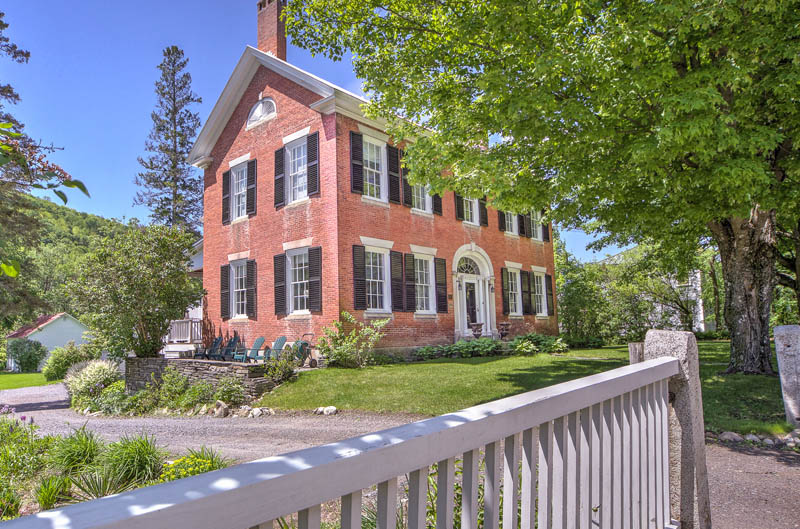
When he set out to put down roots near his hometown of Boston, Favreau fell in love with an old country estate in quaint Chelsea, Vermont. It was the perfect place for this interior designer to escape from the hubbub of big city life after working with celebrity clients and more.

“It was a quintessential Vermont house in a quintessential Vermont town,” said Favreau, about spotting the house in 2012. “I hopped on a plane and bought it the next week.”

Built in 1832, the house was once owned by a man named Aaron Davis, whose family lived in it for at least 100 years. Davis’ granddaughter eventually sold the 23-acre property in the 1980s, and the new owner converted it into a bed-and-breakfast. (There’s still a portrait of Davis above one of the home’s five fireplaces.)

After Favreau purchased the 5-bed, 5-bath home, he sought to restore it to its original grandeur - at a frenetic pace. A contractor brought in a crew to rework everything from the wiring (it was a fire waiting to happen) to the wallpaper (there were eight layers throughout the house). The workers even put in a massive new beam to support the house and keep it from sinking.

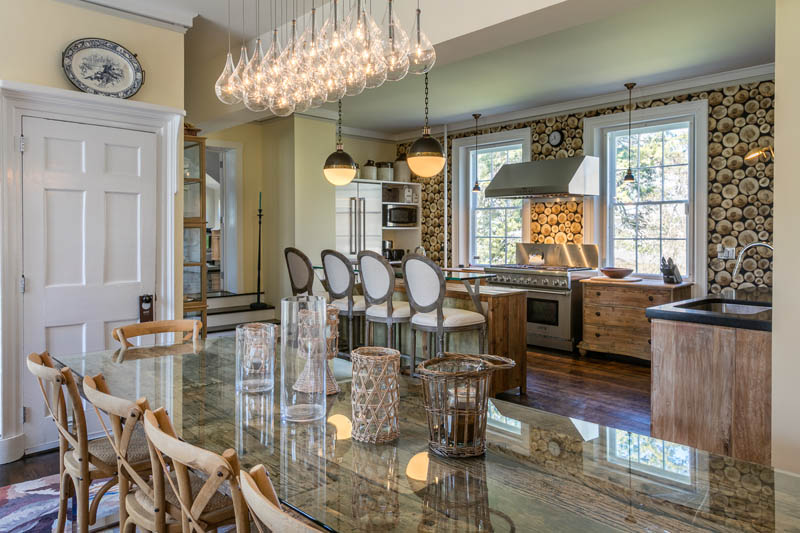
Up next on the designer’s list: keeping the look, feel and integrity of the antique touches, while updating the space to accommodate today’s trends. He tore out a downstairs wall to expand the kitchen to 700 square feet; the master suite got a modern bath with a soaking tub.

Favreau painted walls in his signature bright colors and added bold wallpaper. He lined the master bathroom with tree-print wallpaper. The dining room got a splash of flamingo pink with a print of Victorian-looking cake plates - a nod to the era in which the house was built.

“What I wanted to use for inspiration was the house and the period of the house, so nodding to the period and updating it with a contemporary aesthetic,” Favreau said. “It says today, but it also says yesterday.”

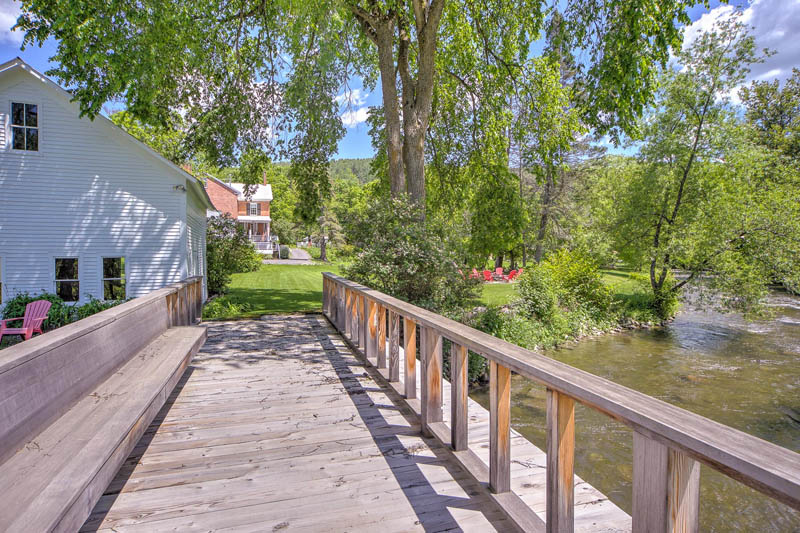
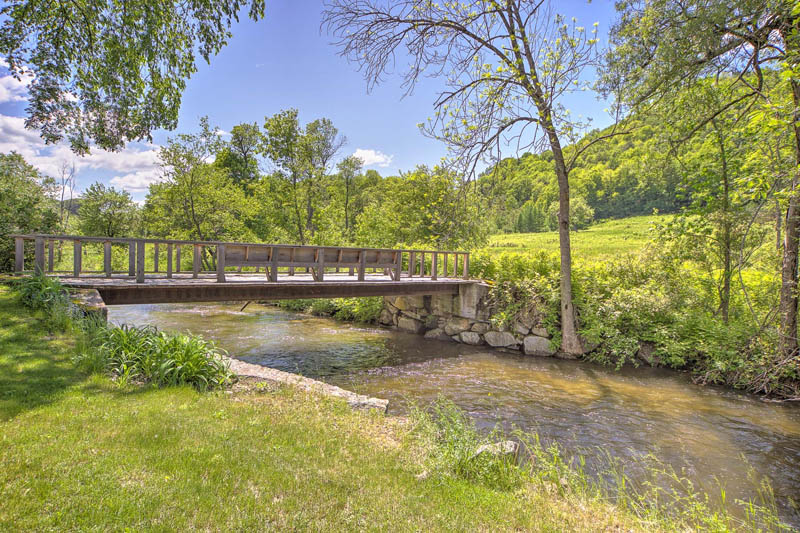
Some things are distinctly New England. A wooden footbridge connects the main property to 22 secluded acres on the other side of the White River. On warm summer nights, Favreau’s family will pull a dining room table out onto the bridge and dine alfresco.

In the winter, the adjacent land allows for snowshoeing or cross-country skiing.

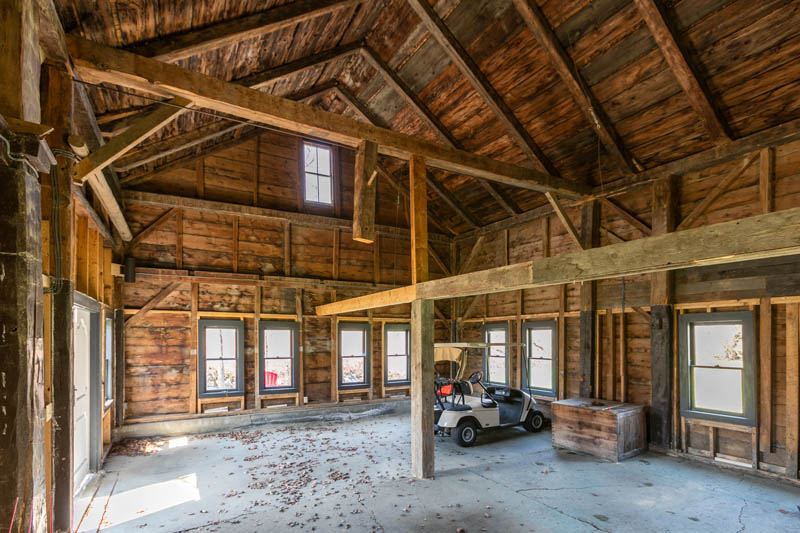
There’s also an old wood barn, which Favreau envisions becoming an event space for weddings or storage. The possibilities for the next owner are limitless, he said.

“It’s a big glorious house, and my family is a big glorious family. We’ve enjoyed it,” he added. “I feel like I’ve loved my time being there and up in Vermont, but it’s time to find the next one. Maybe an oceanside property.”

The home is on the market for $695,000. Zoe Hathorn Washburn of Snyder Donegan carries the listing.

Interior photos courtesy of Jim Mauchly of Mountain Graphics Photography. Exterior photos courtesy of Andrew Holson with Snyder Donegan Real Estate Group.

Related:

Originally published September 2017.


from Zillow Porchlight https://www.zillow.com/blog/historic-vermont-estate-221014/

Thursday, October 25, 2018

7 Places in America That Will Pay You to Move There

If you’re willing to move and if you meet the qualifications, many rural American towns are offering incentives aimed at attracting new residents and reviving their communities.

At the beginning of the 20th century, rural America housed more than half the country’s entire population. While the number of Americans living in rural areas has been roughly stable over the past century - as urban and suburban America have boomed - its share of the total population has declined, falling from 54 percent in 1910 to just 19 percent in 2010.

This is due, in part, to migration to urban cores, especially by younger generations and the middle class.

This decline in population - and the accompanying social and economic challenges - is forcing rural America to come up with incentives to attract new residents back to rural communities.

Tribune, Kansas, offers such a program. “If you move here, we will pay down your student debt,” explains Christy Hopkins, community development director for Kansas’ least populated county, Greeley (in which Tribune sits).

This program, called the Rural Opportunity Zone (ROZ) program, offers perks to grads from big cities for moving to underpopulated towns in one of 77 participating Kansas counties. One of the incentives? They’ll help you pay off your student loans - up to $15,000 over the course of five years.

And it seems to be working - for both the town and its new residents.

“We’re the least populated county - we’re 105th in population for counties in Kansas, and now we’re eighth in college degrees per capita. There’s a correlation to draw,” says Hopkins.

Here are five towns and three states that offer a robust set of loans, programs and/or assistance for those seeking to become homeowners:

Curtis, Nebraska

Population: 891
Median home value: $79,000

Dream of building your own home from the ground up? Curtis, Nebraska, has a sweet deal for you. If you construct a single-family home within a specified time period,  you’ll receive the lot of land it sits on for free.

Marne, Iowa

Population: 115
Median home value: $75,300

Just 45 minutes east of Omaha, Marne will give you a lot of land for free - all you have to do is build the house (conventional construction or modular) and meet program requirements. Houses must be a minimum of 1,200 square feet, and the average lot size is approximately 80 feet by 120 feet.  

Harmony, Minnesota

Population: 999
Median home value: $93,900

Dreaming of a a newly built home in the Land of 10,000 Lakes? Good news: Your dream comes with a cash rebate.

The Harmony Economic Development Authority offers a cash rebate program to incentivize new home construction. Based on the final estimated market value of the new home, rebates range from $5,000 to $12,000, and there are no restrictions on the applicant’s age, income level or current residency.

Baltimore, Maryland

Population: 616,958
Median home value: $116,300

Definitively not a rural town, Baltimore offers homeowners incentives that are too appealing to leave off this list.

Baltimore has two programs offering robust incentives for buying a home in the city. Buying Into Baltimore offers a $5,000 forgivable loan (forgiven by 20 percent each year so that by the end of five years, you no longer have a balance) if you meet certain qualifications.

The city’s second solution is a brilliant one. The Vacants to Value Booster program offers $10,000 toward down payment and closing costs when you buy one of the program’s distressed or formerly distressed properties.

New Haven, Connecticut

Population: 131,014
Median home value: $168,400

Also not a rural area, but offering an incredibly generous package of homeowner incentives, New Haven offers a suite of programs totaling up to $80,000 for new homeowners, including a $10,000 forgivable five-year loan to first-time home buyers, $30,000 renovation assistance and/or up to $40,000 for college tuition.   

Alaska

Population: 739,795
Median home value: $310,200

Alaska offers incentives for veterans and live-in caretakers of physically or mentally disabled residents. They even have a manufactured home program and a rural owner-occupied loan program. See the full list of programs here.

Colorado

Population: 5.6 million
Median home value: $368,100

Colorado offers traditional programs that assist with down payments and low interest rates, but it also has a disability program that helps first-time buyers who have a permanent disability finance their home.

The state also has a down payment assistance grant that provides recipients with up to 4 percent of their first mortgage, which doesn’t require repayment.


Related:

Originally published October 2017. Information updated October 2018.


from Zillow Porchlight https://www.zillow.com/blog/7-places-america-will-pay-move-222241/

Monday, October 1, 2018

5 Reasons to Buy a Home This Fall

Real estate markets ebb and flow, just like the seasons. The spring market blooms right along with the flowers, but the fall market often dwindles with the leaves - and this slower pace could be good for buyers.

If you’re in the market for a home, here are five reasons why fall can be a great time to buy.

1. Old inventory may mean deals

Sellers tend to put their homes on the market in the spring, often listing their homes too high right out of the gate. This could result in price reductions throughout the spring and summer months.

These sellers have fewer chances to capture buyers after Labor Day. By October, you are likely to find desperate sellers and prices below a home’s market value.

2. Fewer buyers are competing

Families who want to be in a new home by the beginning of the school season are no longer shopping at this point. That translates into less competition and more opportunities for buyers.

You’ll likely notice fewer buyers at open houses, which could signal a great opportunity to make an offer.

3. Sellers want to close by the end of the year

While a home is where an owner lives and makes memories, it is also an investment - one with tax consequences.

A home seller may want to take advantage of a gain or loss during this tax year, so you might find homeowners looking to make deals so they can close before December 31.

Ask why the seller is selling, and look for listings that offer incentives to close before the end of the year.

4. The holidays motivate sellers

As the holidays approach, sellers are eager to close so they can move on to planning their parties and events.

If a home has not sold by November, the seller is likely motivated to be done with the disruptions caused by listing a home for sale.

5. Harsher weather shows more flaws

The dreary fall and winter months tend to reveal flaws, making them a great time to see a home’s true colors.

It’s better to see the home’s flaws before making the offer, instead of being surprised months after you close. In fact, the best time to do a property inspection is in the rain and snow, because any major issues are more likely to be exposed.

Top photo from Shutterstock.

Related:

Originally published October 19, 2015.


from Zillow Porchlight https://www.zillow.com/blog/fall-a-great-time-to-buy-185456/